
I love the promise of data mesh: push data ownership to the edges, let domain teams ship data as products, and watch the organization move faster. But here’s the unglamorous truth we keep repeating in classrooms and boardrooms: a mesh without strong, distributed data and analytics governance is just a tangle. Autonomy without agreed‑upon rules yields incompatible data products, brittle integrations, and an ever‑growing integration tax. Governance is not a bolt‑on—it’s the substrate that makes a mesh possible.
Continue reading “No Governance, No Mesh: Why Compatibility Is the Currency of Data Products”Category: Mesh Mondays
Citizen Data Analysts, Citizen Data Scientists, and Citizen Developers—What We Mean (and How They Work Together)
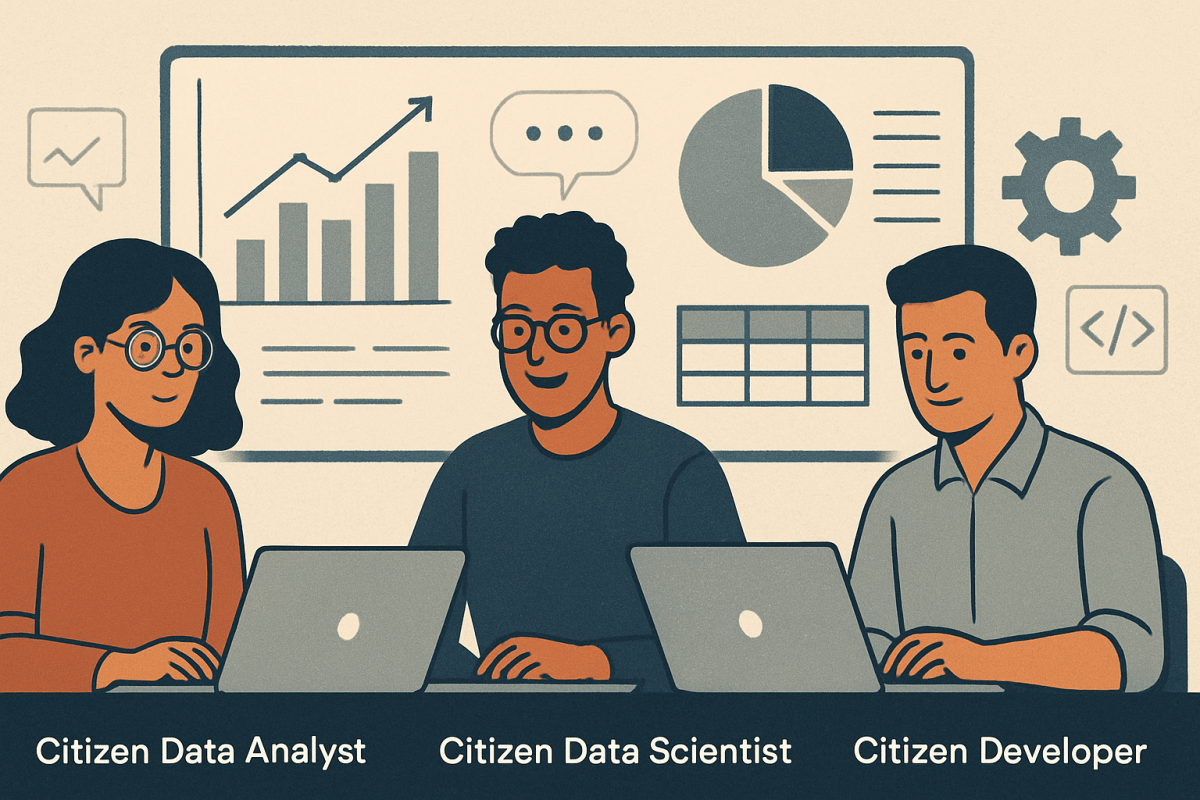
If you’ve been reading along here, you know our north star is putting data to work—safely—where decisions actually happen. Three personas keep showing up in that mission: Citizen Data Analysts, Citizen Data Scientists, and Citizen Developers. They’re adjacent, not identical. Here’s how we define them, how they differ, and how to enable each without creating chaos.
Quick definitions (with Gartner links)
Citizen Data Analyst (CDA)
A domain expert who turns governed data products and a semantic layer into decisions using self‑service BI (dashboards, KPI views, ad‑hoc analysis). Not a Gartner term; it’s our practical label for the power user of curated data.
Citizen Data Scientist (CDS)
A business user who goes beyond visualization to prototype models with guided/augmented tools. Gartner’s definition is often quoted as: “a person who creates or generates models … but whose primary job function is outside the field of statistics and analytics.” See Gartner: Citizen Data Scientist for the glossary entry; a commonly quoted rendering is captured here.
Related Gartner context: augmented analytics “also augments the expert and citizen data scientists by automating many aspects of data science [and] ML.” (Gartner)
Citizen Developer (CD)
A business user who builds apps/automations on approved low‑code platforms. Gartner is concise: a citizen developer is “a persona, not a title or targeted role.” See Gartner: Citizen Developer.
Foundational + Derived Data Products in a Data Mesh

A data mesh is a sociotechnical approach to analytical data that decentralizes responsibility to business domains while standardizing the way data is produced and consumed. It’s grounded in four principles: domain ownership, data as a product, a self‑serve data platform, and federated governance. In practice, it asks each domain team to publish data as a product—discoverable, trustworthy, and operable—while a common platform automates cross‑cutting rules (access, lineage, quality, security).
Zhamak Dehghani frames a data product as an architectural quantum: the smallest independently deployable unit that bundles data, code, metadata, and policy, with a versioned contract and a clear interface (APIs or governed views). Treating both foundational and derived products as quanta is the key to decoupled evolution without breaking interoperability.
Continue reading “Foundational + Derived Data Products in a Data Mesh” EduDataSci - Educating the world about data and leadership