If you’ve ever shipped a feature that “works” and still disappointed users, you’ve met the gap between what a system does and how well it does it. That gap is the space nonfunctional requirements occupy—and it’s where agile teams win or lose product trust.
In this continuation of our requirements series, we’ll clarify the difference between functional and nonfunctional requirements, show how to make nonfunctional requirements measurable, and connect both to practical agile habits—user stories, acceptance criteria, Definition of Done, SLOs, and pipeline checks. By the end, you’ll have a lightweight pattern you can apply this sprint. This is where #RequirementsEngineering meets Agile and DevOps.
A quick refresher: two kinds of intent
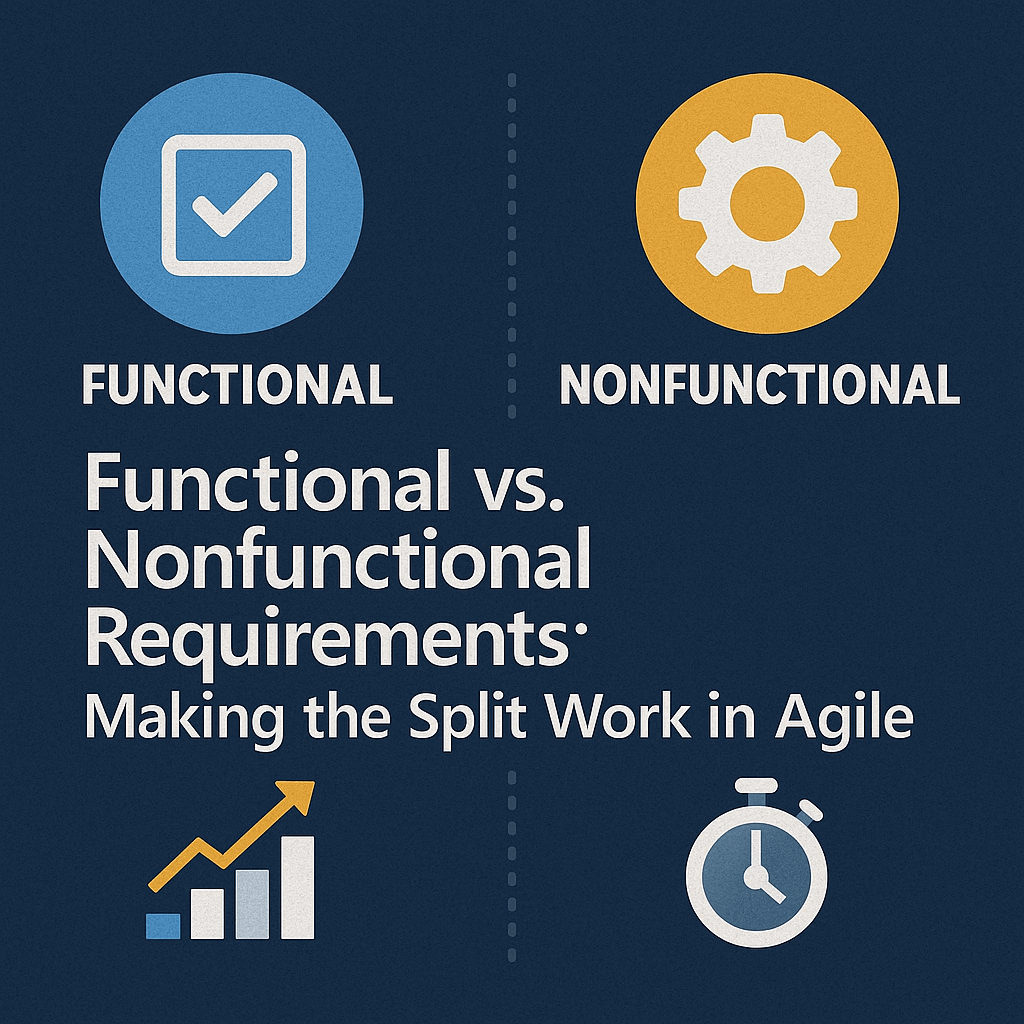
Functional requirements describe capabilities: the observable behaviors users (or other systems) rely on. “A user can reset their password via email.”
Nonfunctional requirements (often called quality attributes) describe properties of the system’s behavior across contexts: performance, reliability, security, usability, accessibility, operability, and cost constraints. “95th-percentile password reset completes in ≤2 seconds under 1,000 concurrent users.”
Both are requirements. Both are testable when written precisely. The difference is scope and measurement: functional behaviors are scenario-specific; quality attributes are cross-cutting and risk-shaping.
Why the split matters
- Architecture and risk. Nonfunctional requirements drive structural choices (caching, isolation, concurrency models) that you can’t bolt on later without cost.
- Flow and forecasting. Functional stories show visible progress; nonfunctional work sustains predictable progress. When you only measure features, you mortgage the future.
| Requirement type | Answers… | Examples | Where it lives in agile |
|---|---|---|---|
| Functional | What must the system do? | “Generate monthly billing statements.” | User stories + acceptance criteria; system and integration tests |
| Nonfunctional | How well, how safely, how reliably? | “P95 statement generation ≤4 min”, “No PII in logs”, “99.9% month-end availability” | Definition of Done, quality bars, SLOs, pipeline gates, enabler stories |
Make nonfunctional requirements measurable with scenarios
A quality attribute becomes actionable when you frame it as a scenario: Source → Stimulus → Artifact → Environment → Response → Response Measure.
- Performance: User (source) requests statement (stimulus) for a typical account (artifact) during peak load of 1,000 RPS (environment); the service returns a PDF (response) with P95 latency ≤4s and P99 ≤6s (measure).
- Availability: During regional failover (environment), the system preserves in-flight jobs (response) with ≤0.1% job loss and recovers within 5 minutes (measure).
- Security: Under OWASP Top 10 probes (stimulus) in staging (environment), no high or critical findings remain open (measure) and all new code paths have authenticated handlers (response).
Scenarios turn adjectives (“fast,” “secure”) into commitments that fit into tests, SLOs, and code review.
From requirement to verification: an agile mapping that works
User stories with acceptance criteria. Keep the story focused on user value, then attach both functional and quality scenarios in the criteria.
Story: “As a customer, I can download my monthly statement.”
Acceptance criteria (functional):
— Statement includes line items, taxes, and totals for the selected month.
Acceptance criteria (quality):
— Performance: P95 ≤4s at 1,000 RPS in staging.
— Security: PDF signed; no PII stored in temp directories.
Specification by Example / BDD. You can express a performance or security threshold just like behavior:
Given a peak-load environment at 1,000 RPS
When a customer requests a statement for an account with 10k line items
Then the PDF is delivered within 4 seconds at the 95th percentile
And the PDF hash verifies against the signing key
Definition of Done (DoD) as the “quality bar.” Make cross-cutting nonfunctional requirements default via DoD, not optional via one-off stories:
- Performance budget checks pass (P95 and P99 thresholds) in CI.
- Security scan shows zero high/critical; new endpoints require authz.
- Accessibility checks show no WCAG AA violations on changed views.
Backlog structure. Keep two representations, one global and one incremental:
- Global quality bars: the enduring nonfunctional commitments (e.g., performance budgets, log privacy). Store them as visible policy artifacts linked from every story template.
- Enabler stories/spikes: incremental work to reach or raise those bars (e.g., introduce async processing to meet P95). Treat them as first-class citizens in planning.
Continuous verification. Wire scenarios into the build as fitness functions—automated checks that fail fast when quality drifts. Typical gates include latency budgets, error budget burn rates, dependency vulnerability thresholds, and bundle size budgets for the frontend.
Operations and learning loops. Link nonfunctional requirements to SLOs and error budgets in production. Use the same numbers in staging tests and dashboards so “what we promise” matches “what we observe.”
Common anti‑patterns (and how to fix them)
- Vague adjectives. “System should be fast.”
Fix: Replace with scenario + numeric budget and percentile. - Parking-lot NFR documents. They live outside the backlog and never influence work.
Fix: Make quality bars part of DoD; reference them in every story template. - End-of-cycle quality. Performance, security, and accessibility tested only at release time.
Fix: Shift left with fitness functions in CI and canary checks in CD. - Local optimization. A single team tunes latency while error budgets burn elsewhere.
Fix: Define SLOs at the user journey level and align team goals to them.
A small, durable template you can adopt today
Use Quality Attribute Cards alongside stories:
- Intent: “Keep invoice generation responsive at scale.”
- Scenario: Source, Stimulus, Artifact, Environment, Response, Measure.
- Verification: Which tests/gates enforce it? Where does it show up in dashboards?
- Status: Current value vs. target; last time we validated.
Then socialize these cards as hyperlinks in story templates and on the team’s README. You’ll see better conversations, crisper estimates, and fewer “surprises” in hardening.
Summary
Functional requirements express the what; nonfunctional requirements set the quality of the what. Treat both as first-class, but manage them differently: stories for capabilities, quality bars and fitness functions for cross‑cutting behaviors. Make nonfunctional requirements measurable through scenarios, wire them into your DoD and pipelines, and tie them to SLOs so the numbers you commit to are the numbers you live by. Fold this into your next sprint planning and you’ll feel the difference.

 EduDataSci - Educating the world about data and leadership