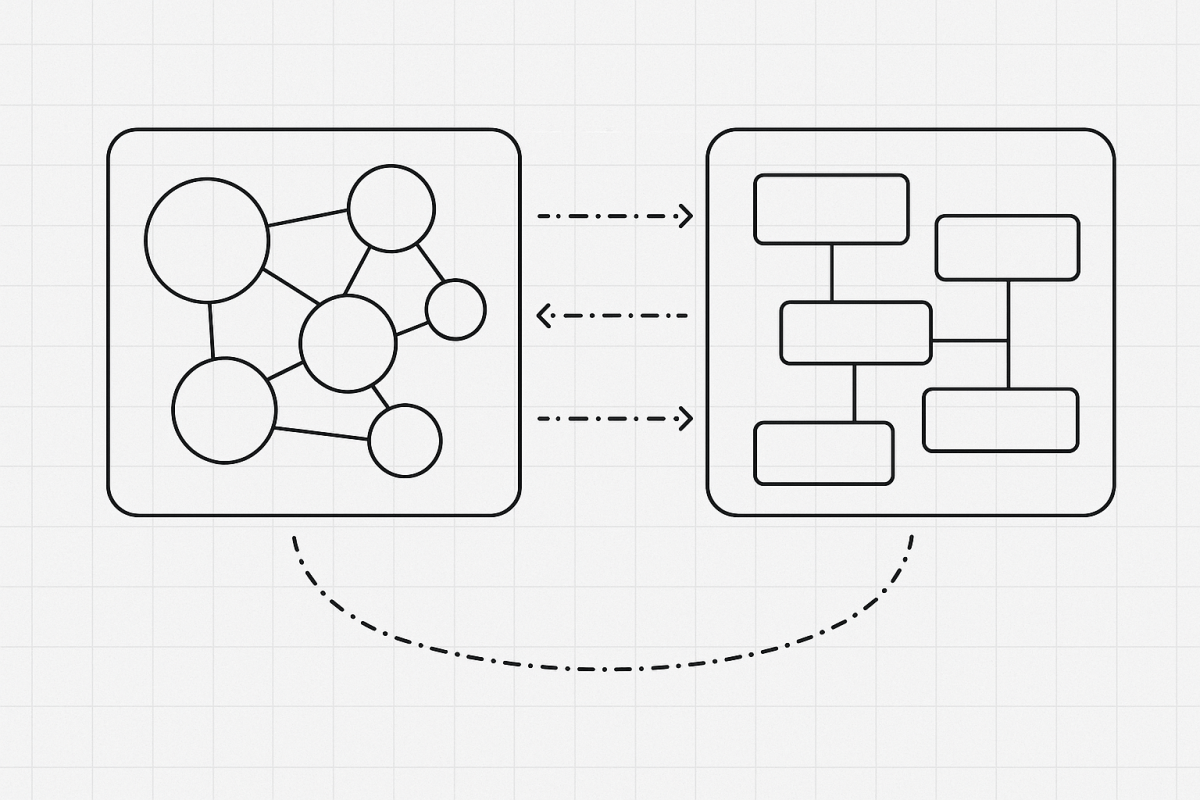
Architecture diagrams look clean—until they collide with the place your system actually lives. That place is not just “production.” It’s your organization: a dense system of systems made of teams, processes, policies, budgets, and tools. The primary reason to understand the organization in which a system will reside is precisely these systems. Your software must integrate with them as surely as it integrates with databases and queues.
I’ll make one argument three ways. First, I’ll define system of systems and show why the org is part of the runtime. Next, I’ll connect business architecture to systems architecture so strategy and structure reinforce each other. Finally, I’ll revisit Conway’s Law—how to use it deliberately and how it can quietly work against you. Then I’ll close with a practical loop you can run before you write code.
The organization is the habitat
A system of systems is a set of independent subsystems that interoperate while retaining their own goals and governance. We often apply this to technology—services, platforms, vendors, data flows. But your organization is also a system of systems: finance cycles, procurement gates, legal reviews, risk committees, HR processes, incident routines, and executive decision forums.
This matters because your new system will not enter a vacuum. It will live inside this organizational ecology, inheriting its interfaces (who approves what), latencies (how long approval takes), and contracts (which policies apply). Think of these as “org APIs.” If you don’t design for these APIs, they will design for you—often late in the project, when change is most expensive.
Common symptoms of ignoring the habitat include features that ship but remain dark behind policy, brittle handoffs at quarter‑end budget windows, and incident playbooks that exist in Confluence but not in muscle memory. These are not tech problems or people problems; they are seam problems in a system of systems.
Business architecture and systems architecture: one picture, two lenses
Business architecture names how value is created—capabilities, value streams, decision rights, and policies. Systems architecture describes how technology realizes that value—domain boundaries, interfaces, quality attributes, and deployment topology. Treated together, they create a cohesive socio‑technical design.
- Capabilities → Domains. Start by naming stable business capabilities (Identity, Pricing, Fulfillment). Map each to a technical bounded context. This is how strategy becomes code without translation loss. #BusinessArchitecture
- Value streams → Service interactions. Trace the customer journey end to end; that path becomes your service dependency path. Latency budgets and SLOs fall out of the stream, not the other way around.
- Policies → Non‑functional requirements. Data retention, auditability, and risk appetite are not afterthoughts; they shape storage choices, event immutability, and release cadence.
- Telemetry → Strategy. Architecture emits leading indicators—flow time, change failure rate, SLO burn. Executives read those signals and tune operating model and investment. The loop closes.
If you can line up capabilities, domains, and teams on a single page, coordination costs drop. When you can’t, the organization fills gaps with meetings.
Why understanding the org is non‑optional (and how to make it visible)
Your system will call more than APIs. It will call people, policies, and calendars. Treat them explicitly:
- Org APIs. Document decision rights, approval thresholds, and expected turnaround as if they were service contracts. Example: “Security review requested via ticket type X; standard SLA 5 business days; exceptions path Y.”
- Friction budgets. Allocate time budgets not just for compute and network latency but for organizational latency: procurement lead time, audit preparation, staffing lag.
- Policy as code. Where possible, encode policy into tooling—pre‑commit checks for PII, automated evidence for audits, deployment guards for separation of duties. This moves governance from meetings to mechanisms.
- Seam ownership. Name owners for seams (interfaces and handoffs) the way you name owners for services. Most outages—and most delays—cluster here.
Make the org legible and your architecture will be evolvable. Ignore it and the org will become the invisible hand that shapes your system anyway.
Conway’s Law: the mirror and the lever
Conway’s Law says systems mirror the communication structures of the organizations that build them. You can lament that—or you can use it.
Leverage it on purpose. Use the Inverse Conway maneuver: design team topology to match the architecture you want. Stream‑aligned teams own stable domains end to end; platform teams provide paved roads; enabling teams accelerate new practices. Align ownership with the flow of value so the codebase “snaps” into place. #ConwaysLaw #OrgDesign
Avoid the traps. Left unattended, the org will imprint accidental constraints on your system. Departmental silos become brittle runtime boundaries. Matrix reporting yields diamond‑shaped call graphs with no clear failure owner. Long approval chains turn into long lead times, which no amount of CI can fully mask.
Conway is not destiny, but it is gravity. Design for it.
A practical residency loop (before you write code)
Use this five‑step loop to place a system in its habitat:
- Model the value. Draft a one‑page capability map and trace the core value stream, including compliance and finance steps, not just the happy path.
- Draw boundaries. Define technical domains to match those capabilities. Publish API/event contracts and the non‑functional goals they must meet.
- Shape the teams. Align stream‑aligned teams to the critical domains. Establish a platform team where multiple streams need shared capabilities (observability, CI/CD, identity).
- Expose org APIs. Write decision and approval contracts as SLAs; automate what you can. Treat policy as code wherever possible.
- Instrument the seams. Measure flow time, SLO burn, change failure rate, and rework at interfaces. When numbers are bad, first ask: “Is this an org seam presenting as a tech defect?”
This loop turns “understand the organization” from a vague directive into a concrete practice.
Summary and next step
We reframed architecture as habitat design. Your system will live inside an organizational system of systems, inheriting its interfaces, latencies, and contracts. Business architecture tells you where value flows; systems architecture makes that flow real in software. Conway’s Law is the mirror—use it to align team topology to desired system shape, or it will shape the system for you.

 EduDataSci - Educating the world about data and leadership