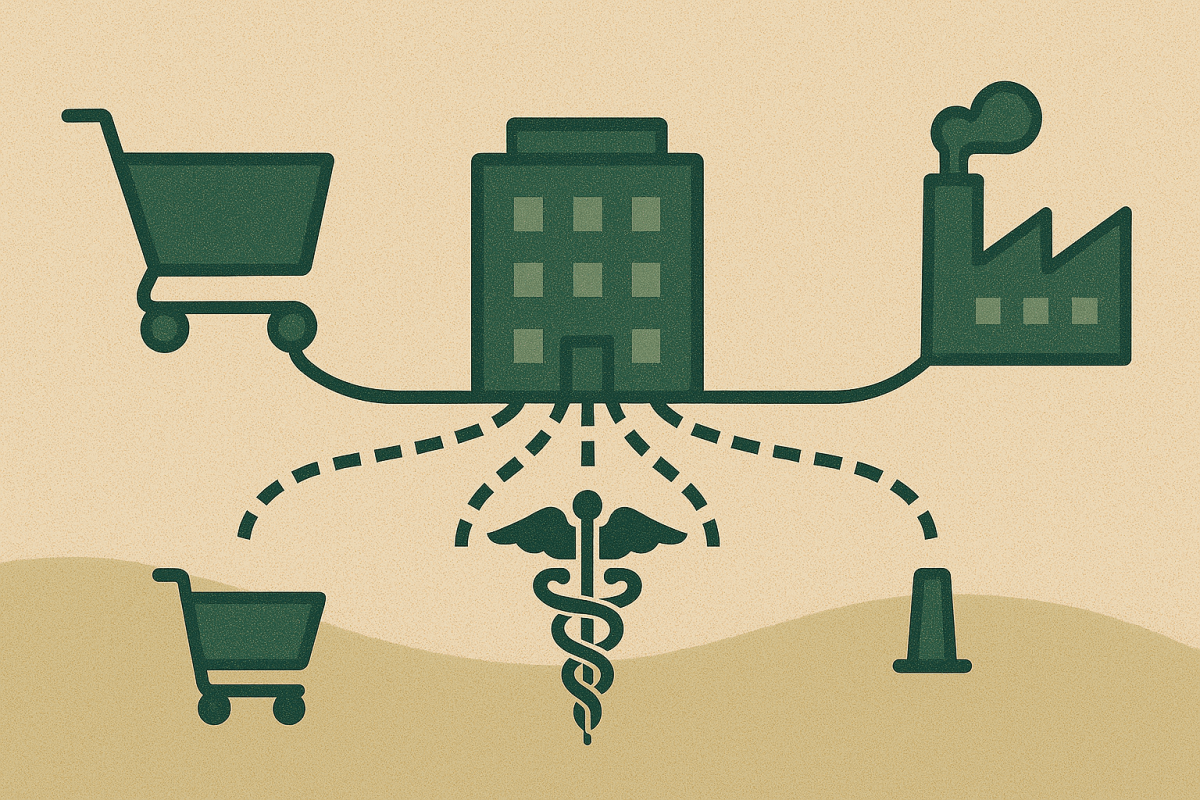
If you’ve skimmed headlines, it’s easy to conclude that data mesh is a Silicon Valley thing—something streaming apps and fintechs use to wrangle petabytes. That mental model sells a lot of tools, but it misses the point. Data mesh is first an operating model—a way to organize people, responsibilities, and guardrails so data can be produced and used where the knowledge lives. That matters just as much (and often more) in organizations whose mission is not building software: manufacturers, hospitals, universities, public-sector agencies, retailers, utilities, and nonprofits.
Quick definition (no buzzwords)
I keep data mesh grounded in four behaviors:
- Domains own data – The people who run the business process are accountable for the data it produces.
- Data as a product – Each shareable dataset is treated like a product with a clear owner, purpose, interface, SLOs, and support.
- Self‑serve platform – A small platform team offers common capabilities (storage, compute, catalog, CI/CD, security, cost controls) so domain teams can publish/consume safely and reliably.
- Federated governance – Policies are defined centrally, implemented computationally, and applied consistently—while letting domains innovate within those guardrails.
None of that requires being a “tech company.” It requires caring about decision quality and the cost of getting data wrong.
Why non‑tech orgs often need data mesh more
1) Domain knowledge sits far from the central data team.
In a hospital, a central analytics team can’t encode the nuance of ICU bed routing or specific documentation workflows as fast or as accurately as the clinical operations team. The same is true for a plant’s scrap reasons, a city’s permitting steps, a university’s enrollment funnel, or a retailer’s promotion mechanics. Mesh puts stewardship where that nuance lives.
2) Centralized backlogs never end.
Most non‑tech orgs run with lean data engineering capacity. Requests queue for weeks, analysts export to spreadsheets, and shadow systems proliferate. Data mesh de‑queues the center by shifting ownership left—domains publish products they depend on anyway.
3) Regulatory and reputational stakes are high.
Healthcare (PHI), government (PII and open records), finance (GL controls), education (FERPA) and utilities (critical infrastructure) can’t afford ad‑hoc access patterns. Federated governance codifies policies once, enforces them everywhere, and shows auditors how they’re implemented.
4) Low‑code and AI is already everywhere.
Power users build apps and automations whether IT likes it or not. Mesh gives those efforts interfaces with guardrails: certified data products with versioned contracts, quality checks, lineage, and access policies—so “citizen development” doesn’t become “citizen risk.” The MIT State of AI In Business report – among many other things – points out that workers from over 90% of companies, despite only 40% of those companies providing AI tools.
5) Cross‑domain questions drive value.
Most meaningful decisions cross organizational boundaries: marketing ↔ supply chain, clinical ops ↔ finance, student success ↔ advising, permitting ↔ zoning. Mesh creates a fabric of shareable, trustworthy data products that can be recombined safely.
Concrete benefits you can expect
- Cycle time from question to answer drops (days not months) because producers and consumers negotiate directlyvia data contracts.
- Trust goes up: each product publishes freshness, completeness, and usage SLOs alongside validation results and lineage.
- Cost control improves: chargeback/showback by product; kill underused ones; scale hot ones.
- Compliance posture strengthens: policies (PII handling, retention, data residency) are defined centrally and enforced by the platform automatically.
- Talent retention improves: domain teams get autonomy to ship; the platform team focuses on leverage, not ticket triage.
How data owners partner with Data & IT (they don’t replace them)
In a mesh, data owners are product owners, not lone wolves. They collaborate tightly with data engineering, analytics, security, and IT operations across the product lifecycle. Think triad: Domain Owner ↔ Data/Analytics ↔ Platform/IT.
Collaboration patterns by lifecycle
1) Discover & prioritize
- Domain Owner frames business outcomes, target users, and decision moments.
- Data/Analytics sizes feasibility, identifies source systems, proposes metrics and methods.
- Platform/IT confirms platform fit, capacity, and any regulatory constraints.
2) Design the interface (contract-first)
- Domain Owner defines meaning: business terms, grain, and acceptable use.
- Data/Analytics translates meaning into a data contract (schemas, SLOs, tests, lineage).
- Platform/IT makes it enforceable (schemas registered, policies as code, CI/CD gates).
3) Build & test
- Data/Analytics implements pipelines, transformations, and semantic layers; sets automated tests for quality and drift.
- Domain Owner performs business acceptance—does this reflect reality?
- Platform/IT provides environments, orchestration, observability, and secrets management.
4) Secure & comply
- Domain Owner classifies data (PII, PHI, sensitive operational).
- Security/Privacy (within IT) codifies handling (masking, retention, residency).
- Platform/IT enforces via RBAC/ABAC, tokenization, and policy checks at query time.
5) Operate (SRE for data)
- Platform/IT runs platform SLOs (availability, performance), incident management, and on‑call.
- Data/Analytics owns product‑level data SLOs (freshness, completeness) and runbooks.
- Domain Owner communicates impact windows, business workarounds, and prioritizes fixes.
6) Evolve safely
- Domain Owner proposes changes driven by business needs.
- Data/Analytics versions schemas, deprecates with notices, and maintains backward‑compatible views when possible.
- Platform/IT enforces change gates (tests pass, consumers acknowledged), and updates catalogs/lineage.
7) Govern & budget
- Platform/IT provides cost telemetry and chargeback/showback per product.
- Domain Owner manages the product roadmap and spend within budget.
- Data/Analytics tunes storage/compute and archives or scales based on usage.
Clear responsibilities (expanded RACI)
| Responsibility | Platform / IT | Data & Analytics | Domain Data Owner | Security / Privacy |
|---|---|---|---|---|
| Platform capabilities (compute, storage, catalog, CI/CD, observability) | R/A | C | I | I |
| Data product contract & schema design | C | R | A | I |
| Pipeline implementation & tests | C | R/A | C | I |
| Business acceptance & definitions | I | C | R/A | I |
| Access control workflows & RBAC | R | C | C | A |
| Data classification & privacy rules | I | C | C | R/A |
| Incident response (platform) | R/A | C | I | C |
| Incident response (data freshness/quality) | C | R/A | C | I |
| Versioning & deprecation policy enforcement | R | R | C | I |
| Cost telemetry & chargeback/showback | R | C | A (budget) | I |
This model keeps IT in the loop and in control of risk, while elevating domain experts to own meaning and outcomes. No one is displaced; each group stops doing the other’s job and excels at their own.
What this looks like outside tech (five short scenarios)
- Manufacturer: Quality & scrap data becomes a “Scrap Events” product from the plant domain; Supplier On‑Time Delivery is a product from procurement. A “Yield & Cost” product composes both. Finance consumes it for accruals; operations use it for real‑time adjustments.
- Healthcare network: “Bed Availability,” “ADT Events,” and “Care Pathway Milestones” are owned by clinical ops; Revenue Cycle owns “Claim Status.” Hospital leadership uses a cross‑domain “Throughput & Denials” product with hourly freshness.
- Retail/CPG: “Store Traffic,” “Promo Calendar,” “POS Sales,” “Inventory Position” are domain products. A “Promo ROI” product composes traffic, promo, and sales with a clear definition of uplift and cannibalization.
- City government: “Permit Applications,” “Inspections,” and “Violations” are products. An “Affordable Housing Pipeline” product composes them and publishes an open-data view with privacy policies applied by the platform.
- University: “Course Enrollment,” “Advising Interactions,” and “Learning Platform Activity” are products. A “Student Success Signals” product aligns to governance rules (FERPA) and publishes only approved features to advisors.
Tools don’t make the mesh; contracts and responsibilities do
A healthy mesh is boringly explicit about who does what and how products behave in production. The crucial artifacts aren’t glossy roadmaps—they’re enforced interfaces (schemas + SLOs + tests), clear ownership, and governance expressed as code. If those exist, the specific warehouse/lakehouse/BI stack matters far less.
“But we already use Data Vault / a data warehouse / a lakehouse…”
Good! Data mesh is complementary to modeling patterns and storage tech:
- Data Vault 2.0 gives you a scalable way to capture raw business keys and relationships (Hubs/Links/Sats).
- Data mesh tells you who owns which parts, how they publish products, and which policies must be enforced.
A common pairing:
- Each domain ingests to a domain vault (or “raw+conform” layer).
- Domain teams build curated data products from that foundation (lakehouse tables, semantic models).
- Cross‑domain products compose via shared business keys and well‑defined contracts, not ad‑hoc joins.
- Governance (catalog, lineage, masking, lifecycle) is platform‑automated and visible to auditors.
Where low‑code and distributed governance meet
Many non‑tech orgs already rely on low‑code solutions to capture ideas, approvals, and workflows across business units. That’s a strength—if you align it with mesh:
- Treat each low‑code app’s analytical output as a data product with an owner, contract, and SLOs.
- Use your platform’s catalog and lineage so employees know which products are certified.
- Route access requests through the platform with policy checks (role, purpose, data class).
- Measure usage and outcomes per product: if no one uses it, archive it.
This turns “citizen development” into citizen product stewardship—and it scales.
Common anti‑patterns to avoid
- “Mesh in name only”: a central team still owns everything; domains just file tickets.
- Tool‑first, purpose‑second: buying a platform ≠ having a mesh. Start with responsibilities, not features.
- Dataset sprawl: products without owners or SLOs. If it’s not a product with a contract, it’s a scratchpad.
- No cost visibility: without chargeback/showback, everything looks free and nothing gets sunset.
- Policy theater: PDF policies no one implements. Governance must be executable and testable.
- “Kill IT” mentality: sidelining platform and security leads to outages and audit findings. Mesh thrives with IT, not against it.
A lightweight governance charter you can adopt
- Purpose: Enable domain autonomy while protecting customers, employees, and the organization.
- Board: Platform lead (chair), Security/Privacy lead, and the Data Product Owners from each domain.
- Meets: Bi‑weekly; publishes decisions and policy‑as‑code changes.
- Decides: Data classes & handling, naming/versioning conventions, SLO minimums, deprecation rules, incident severity, and review gates for breaking changes.
- Measures: % products with owners, % with contracts & SLOs, policy compliance rate, mean time to access, freshness attainment, product adoption, and unit cost per query.
A final nudge
If your mission is to deliver care, keep lights on, educate students, build safer cities, or make great physical products, you are already a data company—you just can’t afford to pretend otherwise. Data mesh won’t make you “tech.” It will make your expertise operable: turning local knowledge into reliable, shareable products, protected by guardrails you can prove work.
Start by reshaping the relationships: elevate domain owners to product owners, empower data teams to build and test to contracts, and keep IT in the loop to automate governance and run the platform. That’s the mesh.

 EduDataSci - Educating the world about data and leadership