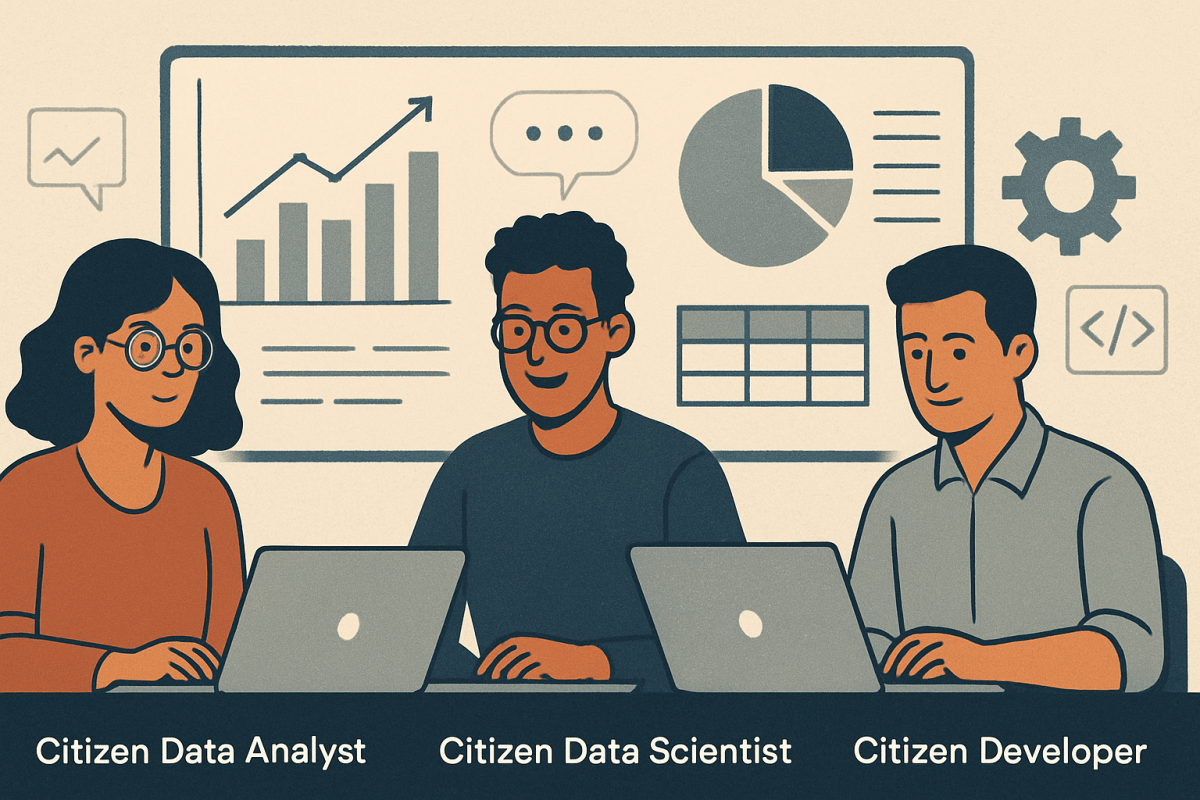
If you’ve been reading along here, you know our north star is putting data to work—safely—where decisions actually happen. Three personas keep showing up in that mission: Citizen Data Analysts, Citizen Data Scientists, and Citizen Developers. They’re adjacent, not identical. Here’s how we define them, how they differ, and how to enable each without creating chaos.
Quick definitions (with Gartner links)
Citizen Data Analyst (CDA)
A domain expert who turns governed data products and a semantic layer into decisions using self‑service BI (dashboards, KPI views, ad‑hoc analysis). Not a Gartner term; it’s our practical label for the power user of curated data.
Citizen Data Scientist (CDS)
A business user who goes beyond visualization to prototype models with guided/augmented tools. Gartner’s definition is often quoted as: “a person who creates or generates models … but whose primary job function is outside the field of statistics and analytics.” See Gartner: Citizen Data Scientist for the glossary entry; a commonly quoted rendering is captured here.
Related Gartner context: augmented analytics “also augments the expert and citizen data scientists by automating many aspects of data science [and] ML.” (Gartner)
Citizen Developer (CD)
A business user who builds apps/automations on approved low‑code platforms. Gartner is concise: a citizen developer is “a persona, not a title or targeted role.” See Gartner: Citizen Developer.
| Persona | Primary goal | Typical tools | Outputs they own | What they don’t own |
|---|---|---|---|---|
| Citizen Data Analyst | Turn governed data into decisions | BI + semantic layer, governed datasets | Dashboards, KPI views, ad‑hoc analyses | ML models, data pipelines, app delivery |
| Citizen Data Scientist | Explore/predict with guided ML | AutoML, augmented analytics, light notebooks | Prototypes, feature ideas, what‑if models | Production ML, model risk, MLOps |
| Citizen Developer | Digitize workflows & front doors | Low-/no‑code app + automation platforms | Forms/apps, approvals, micro‑workflows | Enterprise architecture, security policy |
The common denominator is discoverable, governed data products—clear contracts, protections, and consistent metrics.
What each role is / is not
Citizen Data Analyst
- Is: A power user of curated data who can frame questions, slice cohorts, and communicate insights.
- Is not: A data engineer, statistical modeler, or app developer.
- Shines when: Monitoring KPIs, spotting anomalies, telling data stories to decision‑makers.
Citizen Data Scientist
- Is: A domain expert who can move from descriptive to predictive/driver analysis using augmented tools.
- Is not: Responsible for production ML or model risk. Treat their work as exploratory prototypes until reviewed.
- Shines when: Perfroming hypothesis generation, quick propensity sketches, driver analysis, feature ideas.
- Anchor: See Gartner: Citizen Data Scientist
Citizen Developer
- Is: The builder of small, high‑impact apps/workflows on sanctioned platforms.
- Is not: Shadow IT. Their apps respect data contracts, DLP, and deployment rings.
- Shines when: Creating intake forms, approvals, light case tracking, “glue” between systems.
- Anchor: Gartner: Citizen Developer—“a persona, not a title or targeted role.”
Industry use cases: Insurance
For Citizen Data Analysts (CDA)
- Claims & loss‑ratio transparency
Claims leaders use governed claims/policy data to track volume, aging, payouts, and loss ratios by product/region—moving away from scattered spreadsheets to governed dashboards with drill‑through. Even mainstream carriers and MGAs are standardizing claims, broker, and exposure views in Power BI/BI hubs for day‑to‑day operations and reserving prep. (Insurance Data Solutions, bitwiseglobal.com) - Underwriting performance & pipeline health
Underwriting managers monitor quote‑to‑bind, hit ratios, pricing adequacy, and referral rates by segment—replacing fragmented Excel processes the industry has leaned on for years. (The FT recently chronicled this shift as underwriters modernize tooling beyond Excel.) (Financial Times)
Why it matters: Better visibility reduces cycle time and rework pre‑ and post‑bind; central BI cuts “multiple truths” risk before quarter close.
For Citizen Data Scientists (CDS)
- Claims triage & severity prototyping
Using augmented analytics or AutoML, claims domain experts can prototype severity or complexity scores (e.g., from photo or metadata inputs), then hand off to pro DS/MLOps for production and monitoring. Real‑world programs show AI‑assisted vehicle damage assessment speeding claims estimation while maintaining accuracy. (PwC) - Fraud risk signals with business‑rule overlays
Citizen teams explore features (claim history, provider patterns) to propose fraud‑risk scores, with pros validating leakage/bias and integrating with rule engines. (See a published health‑insurance fraud case on combining ML with business rules.) (variancejournal.org) - AutoML for actuaries/underwriters
Evidence continues to grow that AutoML workflows can put robust ML within reach of non‑specialists in insurance—when paired with governance and pro review. (ScienceDirect)
Why it matters: CDS work accelerates hypothesis testing and feature ideation; production remains a specialist responsibility with model risk controls, as Gartner’s augmented‑analytics view implies.
For Citizen Developers (CD)
- FNOL intake, recoveries & approvals
Ops staff build low‑code apps to capture First Notice of Loss, trigger document requests, and route approvals—on sanctioned platforms with DLP and RBAC. - Center of Enablement (CoE) model at scale
Zurich Insurance launched a Power Platform Center for Enablement (C4E) to grow citizen development with governance—balancing innovation and control across a global insurer. (Microsoft)
Why it matters: Low‑code apps remove swivel‑chair work and close process gaps without spawning shadow IT—if you standardize environments, connectors, and promotion paths.
Why the distinctions still matter (even in these industries)
- Safety & compliance: Insurance models touch reserving, pricing, and fraud controls; manufacturing models touch safety and quality. CDS prototypes must handoff to pro DS/MLOps, with monitoring and rollback—Gartner’s ModelOps and augmented‑analytics guidance align here. (Wikipedia, Gartner)
- Speed with accountability: CDAs and CDs move fast inside guardrails; specialists focus on data products, pipelines, model risk, and platform operations.
- Talent flywheel: Upskill domain experts where context lives; let specialists industrialize.
Anti‑patterns to avoid
- “Everyone’s a data scientist now.” No. CDS is exploratory. Don’t bypass professional review, fairness checks, and MLOps. Gartner’s augmented‑analytics stance is explicit: these tools augment both experts and citizen roles. (Gartner)
- Low‑code sprawl. Unbounded connectors and personal‑scope apps with sensitive data. Fix with environments, DLP, and clear promotion criteria; large enterprises like Zurich have formalized this via a CoE. (Microsoft)
- Spreadsheet islands in underwriting/manufacturing. Centralize logic into data products and semantic layers; even industry press notes the limits of Excel for modern underwriting. (Financial Times)
Putting it together (the mesh view)
Think of data products as paved roads, the semantic layer as signage, and these citizen personas as drivers with different destinations. Keep the roads smooth, make the signs unambiguous, license the drivers appropriately—and you’ll get speed and safety.

 EduDataSci - Educating the world about data and leadership