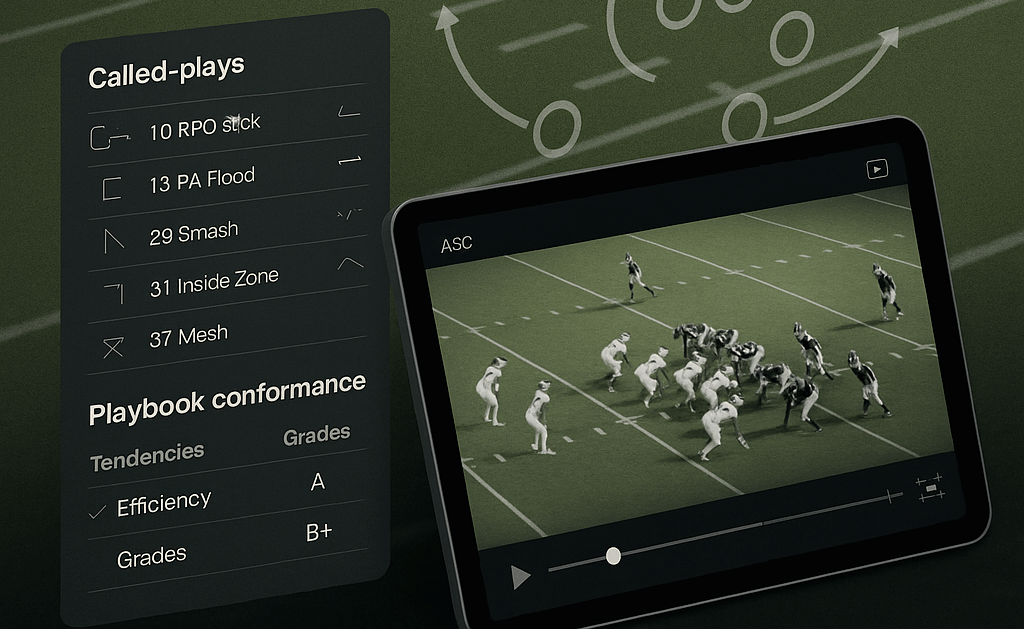
The lights go out, the sideline file finishes uploading, and the play list—your record of the plays actually called—lands in the same folder. While everyone sleeps, AI could take those two inputs (plus your existing playbook in the system) and quietly do the digital chores, so Saturday starts with coaching, not clicking.
Critical note—what we mean by “AI.” Under the hood it’s a layered system: it first perceives (finds players, the ball, the snap), then abstracts (turns detections into football concepts like formations, movements, fronts, and route families), and finally reasons (rolls concepts into tendencies, playlists, and draft grades). It tracks confidence and asks a human when it’s unsure. Everywhere else here, we’ll just call it AI.
One continuous overnight flow (film + called‑plays play list + playbook)
You upload the game film (we’ll assume the sideline “Wide” view; End‑zone and any practice “Madden View” just add detail and expectations). You also upload the play list from the game—codes/names for the calls you actually made, in order. The system already has your playbook (the calls you can make, with landmarks, rules, families, and options). From there, the night shift looks like this:
1) Map the context
The AI reads your playbook’s structure (families, tags, expected landmarks, protection rules) and your vocabulary (“we call Quarters ‘Sky’,” “GT Counter is ‘22’”). It ingests the called‑plays play list and normalizes call names so “22 GT Lt” and “GT Counter L” both route to the same playbook entry.
2) Segment the film and find the field
It splits the video into snaps, trims dead time, and, if the end‑zone view is present, syncs angles by timecode. It “reads” hash marks and yard lines to express positions in yards, not pixels.
- Sideline only: strong for formations, motions, route landmarks, launch points, and broad coverage shell family (1‑high / 2‑high / 0).
- End‑zone (if present): sharper trench details—line splits, strike timing, combo points, protection sorting, run‑fit integrity.
- Madden View (from practice): teaches spacing rules and jersey IDs; helps recognition on game tape and produces crisp install clips.
3) Align the called plays to the snaps (play list ↔ film ↔ playbook)
For each snap, the AI proposes a link to the exact call from your play list and the canonical playbook entry behind it. If the on‑field look clearly matches a sister concept or check, it flags the mismatch and asks: “Was this ‘Stick F‑Choice’ or the ‘Stick‑Nod’ check?” Low‑confidence links go into a fast review queue (yes/no choices). Ten focused minutes on Saturday can clean an entire game.
4) Draft tags that honor your language
With the call aligned to the snap, the AI drafts tags you can batch‑approve:
Offense:
- personnel (when visible)
- formation family (2×2, 3×1, bunch/condensed)
- motion type
- run family (IZ/OZ/Counter/Power)
- pass‑concept family (Stick/Mesh/Flood)
- coarse protection
Defense:
- front family (even/odd/mint)
- pressure family (edge/creeper/stack)
- stunt family (e.g., TEX)
- shell family
Situation:
- down/distance
- field zone
Anything uncertain is marked with a confidence bar and a one‑click question.
5) Measure the essentials (with visible confidence)
- From sideline: receiver/TE splits, motion speed, route landmarks, time‑to‑throw (coarse), depth of target, pursuit angles, initial leverage.
- With End‑zone: OL splits and get‑off timing, hand‑placement proxies, combo‑to‑climb timing, protection sorts, run‑fit lanes/missed‑fit locations.
Every metric shows a confidence bar; yellows bubble to the top of your review.
6) Playbook conformance (did we run it like we coach it?)
Because the play is now linked to a playbook entry, the AI checks execution vs. design:
- Routes: Did landmarks match the playbook (depth/width)? Were conversions/sight‑adjusts applied when the playbook calls for them?
- Protections: Was the sort correct vs. the look? Were pass‑offs clean? Are there any free runners attributable to the call or the execution?
- Runs: Were double‑team durations and aiming points close to the rules? Did puller path/ depth fit the diagram?
Deviations are annotated with the exact frames and a short rationale (“Z break at 8y vs. 12y landmark”).
7) Draft grading—receivers, routes, and linemen (coach‑edited)
These are pre‑filled grades tied to evidence; you approve or adjust quickly. Your rubric, your scale. Low confidence grades bubble up for your review.
- Receivers (WR/TE/RB when relevant): Alignment & split vs. playbook landmark. Release & leverage (clean vs. jam; leverage won/lost). Route stem & top (crisp vs. rounded; break timing vs. expected depth). Separation at target (approx. from sideline). Hands/catch technique (angle‑dependent confidence). Perimeter block (engage/sustain without penalty; End‑zone raises confidence). Each grade links to frames at the break/catch/block and a one‑line rationale.
- Routes (concept fidelity & spacing): Landmark accuracy per the playbook. Timing vs. QB (available on time relative to drop/release). Spacing with companion routes (no collisions; purposeful distribution). Conversions/sight‑adjusts when the playbook expects them. “Job within the job” credit (clear‑outs, occupancy) even when not targeted.
- Offensive line (End‑zone helps; sideline still produces a draft): Get‑off & first step vs. assignment. Pad level & posture (pose proxies; confidence shown). Strike & hands timing/placement (where visible). Footwork path (bucket/drive/skip‑pull) vs. call. Combo & climb timing. Protection sort (IDs, pass‑offs, any free runner). Finish & penalties.
8) Usage, tendencies, and efficiency (by called play and by family)
Now the overnight boards mean more because they’re grounded in what you actually called:
- Usage: How often each playbook concept appeared; where on the field; into which shells.
- Efficiency: Yards/attempt, success rate, explosives, pressure/TTT effects—by play and by family.
- Sequencing: What you tended to call after successful IZ, after a boundary throw, after a penalty.
- Opponent response: Their most common front/shell/pressure family vs. your top five calls.
Every headline links to a tight cut‑up—2–3 clips that best teach the point.
9) Saturday deliverables (ready when you unlock the fieldhouse)
- One‑page Team Sheet: Five to seven bullets, three swing plays with “why,” two self‑scout items worth fixing, and practice emphasis tied to your playbook (“IZ double to 2i—strike timing,” “Stick spacing vs. 2‑high—break‑depth discipline”).
- Position playlists: “WR route‑top corrections,” “OL combo timing & pass‑offs,” “DL rush‑lane discipline,” “Explosives for/against by family,” “3rd‑and‑medium vs. 2‑high,” “Protections that leaked a free runner.”
- Playbook coverage: Which playbook calls saw the field, which didn’t, and where variants or checks emerged (with evidence).
- Review queue: A short list of low‑confidence tags/grades with yes/no prompts; thirty minutes clears it, instead of four hours of film at 4 AM.
If you only have the sideline angle (still with play list + playbook)
You still get reliable call alignment, useful tendencies and efficiency by the plays you actually called, route/receiver draft grades with evidence, and all the teaching playlists. Trench details (and contested‑catch nuances) show more yellow until coach eyes confirm. Adding even partial end‑zone views in short‑yardage/red‑zone meaningfully improves interior grading. A short Madden View segment from a drone during practice (10 minutes) helps the system learn your spacing rules and produce sharper install clips, even if games never include overhead shots. (Make sure that your drone pilot is licensed and follows FAA regulations, the latest ones provide a lot of options for using drones, but FAA rules are strict).
Guardrails that keep this coach‑first
- Your words, everywhere: The AI uses your playbook names and defensive terminology end‑to‑end.
- Evidence on every claim: Clips/stills back every tag, alignment, and grade.
- Confidence visible: Low‑confidence items become quick questions, not hidden guesses.
- Development over leaderboards: Grades serve teaching, not public rankings.
- Policy‑friendly: Keep film on school‑controlled storage; follow local guidance for overhead capture.
A digital coach’s assistant adds even more, offering ad-hoc assistance and clips
Adding a digital coach’s assistant (not a digital assistant coach) makes this even more powerful, allowing a coaching staff to work through an interactive exploration process together, rapidly building cut lists and answering questions that come up during filming review and scouting. Some sample questions you could ask are below:
- “Show every snap where we called ‘Stick’; grade route‑top depth vs. the playbook landmark and pull three clean teaching reps.”
- “Find Counter GT calls with puller depth > 3 yds; build a 10‑clip cut‑up.”
- “List protections that produced a free runner vs. slide; show representative clips and the sort error.”
- “Which playbook calls didn’t appear last night, and where would they have fit based on looks we got?”
- “Create personalized lists of plays for players. Include both successes and areas of growth.
Bottom line
With film, a called‑plays play list, and your playbook already in the system, AI can connect design to execution while you sleep—organizing snaps, aligning calls, checking playbook conformance, surfacing tendencies and efficiency, and drafting grades for receivers, routes, and linemen. Sideline‑only footage gets you surprisingly far; End‑zone and occasional Madden View make it sharper. The tech doesn’t call plays or give speeches—it just makes sure you show up on Saturday with the right film, the right questions, and more time to coach.
The possibilities of this type of system are endless. It’s not about replacing coaches or teaching players on its own, but it is the kind of thing – like AI in so many other species – that can make coaches better. Can give them their time back, let them spend their time teaching, coaching, and developing players into better athletes and better students. By freeing up coaches and players time, we let these scholar athletes learn the science of their game, and learn how to apply perseverance, self-study, goal-oriented thinking, and teamwork not just in football, but the rest of their lives.

 EduDataSci - Educating the world about data and leadership